Singapore homes are changing — and so are the lifestyles within them.
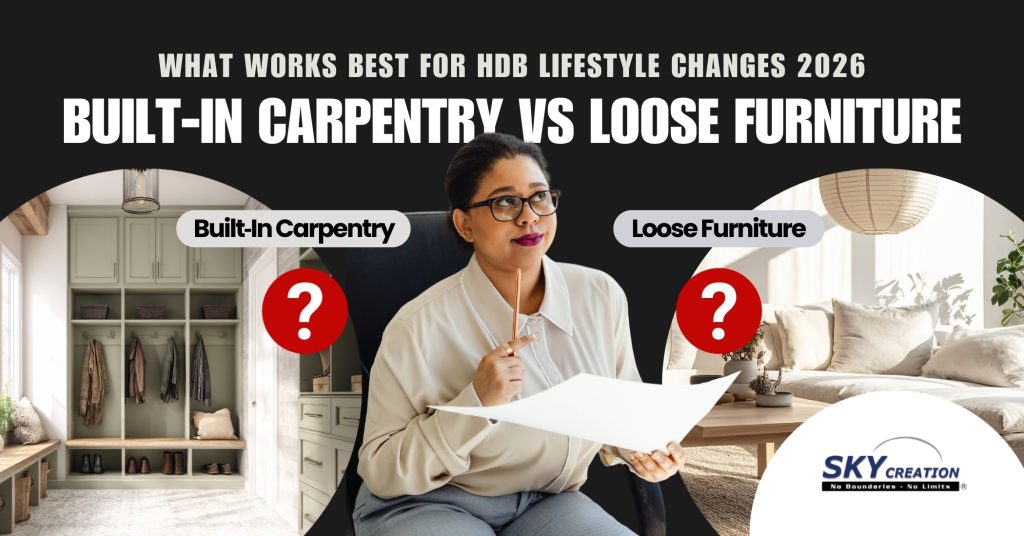
In 2026, HDB flats are no longer just places to live. They are home offices, family hubs, rest spaces, and storage centres all rolled into one. With rising renovation costs, limited space, and evolving household needs, homeowners are increasingly asking one important question:
Should I invest in built-in carpentry, or rely on loose furniture instead?
The answer is no longer black and white. What works best depends on how your lifestyle is changing, how long you plan to stay, and how efficiently you want to use your space.
This guide breaks down the real differences between built-in carpentry and loose furniture — specifically for modern HDB living in 2026 — so you can make a decision you won’t regret.
The Reality of HDB Lifestyle Changes in 2026
HDB homes today face very different demands compared to a decade ago:
- More people working from home
- Multi-generational households becoming common
- Smaller bedroom sizes in newer flats
- Higher storage needs with minimal clutter tolerance
- Longer homeownership periods
A renovation that looks good but doesn’t adapt to lifestyle changes quickly becomes a problem.
This is why choosing between built-in carpentry and loose furniture is now a strategic decision, not just a design preference.
What Is Built-In Carpentry?
Built-in carpentry refers to custom-made fixtures that are permanently installed and designed specifically for your home’s dimensions.
Common examples include:
- Full-height wardrobes
- Built-in TV feature walls
- Platform beds with storage
- Study desks integrated into walls
- Bench seating with hidden compartments
Built-ins are planned during renovation and become part of the home’s structure.
What Is Loose Furniture?
Loose furniture includes movable, standalone pieces such as:
- Wardrobes
- Beds and sofas
- Cabinets and shelves
- Dining tables and chairs
They can be purchased off-the-shelf or custom-made, but are not fixed to the home.
Loose furniture offers flexibility, but may not always maximise space efficiently — especially in smaller HDB flats.
Built-In Carpentry: Strengths and Limitations
Why Homeowners Choose Built-In Carpentry
1. Maximum Space Efficiency
Built-ins are designed to fit wall-to-wall and floor-to-ceiling, eliminating dead space that loose furniture often leaves behind.
2. Cleaner, More Cohesive Look
Integrated carpentry creates visual continuity, making small spaces feel calmer and more organised.
3. Storage Tailored to Your Lifestyle
From shoe cabinets sized exactly to your family’s needs to wardrobes designed around your actual clothing habits, built-ins solve real daily problems.
4. Ideal for Long-Term Living
If you plan to stay for many years, built-ins provide durability and consistency.
Where Built-In Carpentry May Not Be Ideal
- Higher upfront cost
- Less flexibility to reconfigure layouts
- Not ideal for homeowners planning to move soon
Built-ins require thoughtful planning — mistakes are costly to undo.
Loose Furniture: Strengths and Limitations
Why Some Homeowners Prefer Loose Furniture
1. Flexibility
Loose furniture can be rearranged, replaced, or removed easily as needs change.
2. Lower Initial Cost
You can furnish gradually instead of committing to large renovation costs upfront.
3. Easier for Short-Term Stay
Ideal for homeowners planning to upgrade or move within a few years.
Where Loose Furniture Falls Short in HDB Flats
- Inefficient use of space
- Gaps between furniture and walls
- Visual clutter in small rooms
- Limited storage compared to built-ins
In compact flats, too many loose pieces often make the home feel cramped faster.
Space Efficiency: The Biggest Difference
In HDB homes, space efficiency is everything.
Built-in carpentry:
- Uses vertical height fully
- Integrates storage into beds, benches, and walls
- Keeps walkways clear
Loose furniture:
- Consumes floor space
- Leaves unused gaps
- Often requires more pieces to achieve the same storage
For small bedrooms and living areas, built-ins generally outperform loose furniture.
Adapting to Lifestyle Changes Over Time
For Young Couples
A mix often works best:
- Built-in wardrobes
- Loose furniture for living areas
For Families with Children
Built-ins provide:
- Safer layouts
- More organised storage
- Better long-term durability
For Elderly-Friendly Homes
Built-ins allow:
- Lower pull-out storage
- Clear walkways
- Ergonomic design
Loose furniture alone often struggles to meet these evolving needs.
Cost Consideration: Short-Term vs Long-Term Value
While loose furniture may appear cheaper initially, repeated replacements and inefficient storage can add up.
Built-in carpentry:
- Higher upfront cost
- Better long-term value
- Less replacement needed
The key question is not “Which is cheaper?” but “Which suits how long and how you’ll live here?”
Side-by-Side Comparison
| Aspect | Built-In Carpentry | Loose Furniture |
|---|---|---|
| Space Efficiency | High | Medium |
| Storage Capacity | Custom & maximised | Limited |
| Flexibility | Low | High |
| Visual Neatness | Very clean | Can be cluttered |
| Best for Long Stay | Yes | No |
| Best for Short Stay | No | Yes |
Common Mistakes Homeowners Make
- Choosing loose furniture for small bedrooms
- Over-building carpentry without future planning
- Prioritising looks over storage needs
- Mixing too many furniture styles in small spaces
The best homes are strategically balanced, not extreme.
Frequently Asked Questions (Practical & Answer-Based)
Which is better for small HDB flats — built-in carpentry or loose furniture?
For small HDB flats, built-in carpentry usually offers better space efficiency, while loose furniture works better for flexibility.
Can I combine both in one home?
Yes. Many homeowners use built-ins for storage-heavy areas and loose furniture for flexible spaces.
Is built-in carpentry worth it if I may move in the future?
If you plan to move within a few years, loose furniture may make more sense.
Does built-in carpentry increase resale value?
Well-designed carpentry that enhances storage and layout can improve buyer appeal.
What’s the biggest deciding factor?
How long you plan to stay and how much storage you truly need.
Making the Right Choice in 2026
There is no universal answer.
The best homes in 2026 are designed around:
- Lifestyle
- Duration of stay
- Storage behaviour
- Family structure
Built-in carpentry and loose furniture are tools — the outcome depends on how intelligently they are used.
Ready to Plan Your Space Properly?
If you’re unsure which approach suits your home, a professional space planning consultation can save you from costly mistakes.
👉 Get a Free Space Planning & Renovation Quote
https://skycreation.com.sg/get-free-quote/
📲 WhatsApp Our Design Team
https://wa.me/6589567691